
Our Impact
Making A Difference In Our County
UGA Extension is working diligently to help the people in our county. The following is the Extensions Impact during the year 2025.
Select Here for Annual Report Here pg. 1
Select Here for Annual Report Here Pg. 2
ANR
Summary
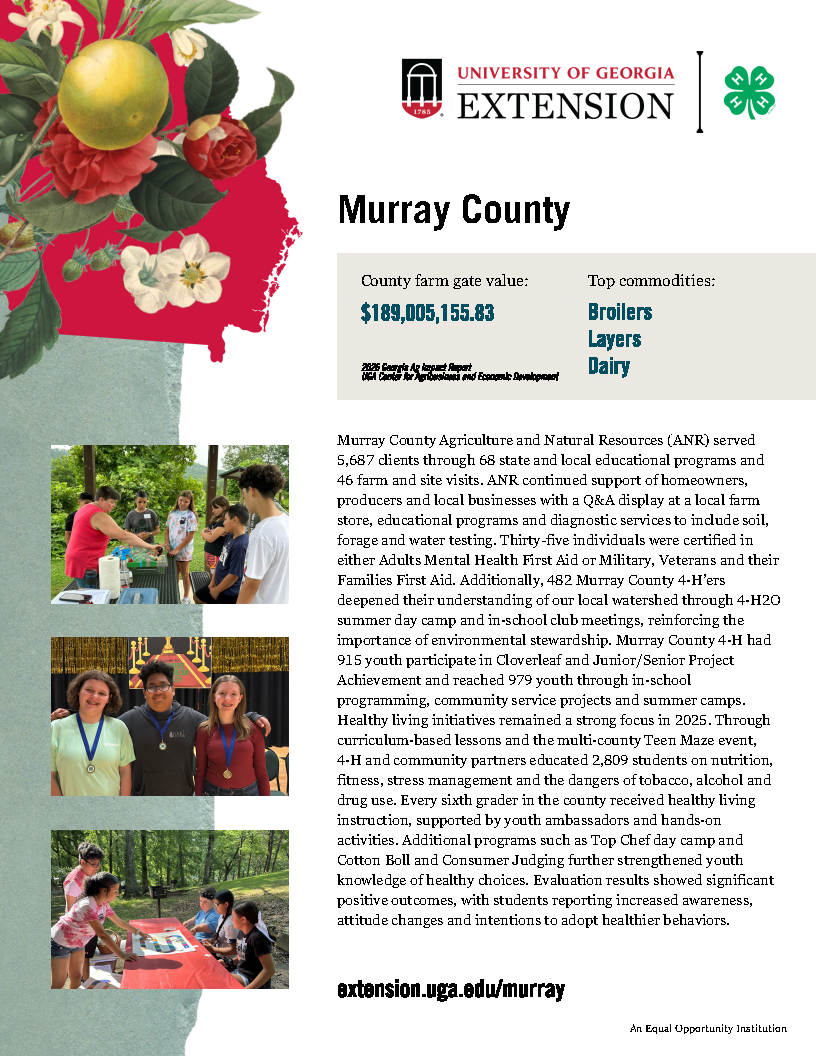
Murray and Whitfield County Extension offered an opportunity for experiential learning, All About Water summer day camp, which provided a chance for 4-H'ers to expand their network of friends beyond their home community and work cooperatively in an outdoor classroom environment conducive to learning
Situation
Flowing out of the Cohutta Wilderness area and up into Tennessee before returning to Georgia, the Conasauga River watershed is one of the most biologically diverse rivers in North America that is also home to many threatened or endangered aquatic species. According to the Georgia River Network, this river ranks " first in imperiled species in the Coosa River Basin." As an added benefit, it provides an excellent outdoor classroom, exposing youth to a wide variety of aquatic life and learning to identify wildlife present in our community as well as conservation and preservation of endangered species unique to the Conasauga River. Murray and Whitfield County Extension consistently work to raise awareness and support improving the environment through learning opportunities with 4-H'ers, exposing then to concepts previously only covered in the classroom.
Response
Agents from both Murray and Whitfield County Extension collaborated on a summer day camp, All About Water, at Haig Mill Park, Dalton, GA. Curricula were chosen to create a fun, experiential learning water science day camp.
Impact
Twenty-nine 4-H'ers from Murray and Whitfield counties from grade levels 4th through 12th participated in a round-robin type event with situations on the history of the park at Haig Mill Lake; Protecting Watersheds; Fishing and aquatic wildlife conservation and Water as a nutrient. A pre/post survey was given to attendees at the day camp to measure what they already knew before the day camp ( none, a little or a lot ) and what they remembered afterward. The favorite lesson of the day were Fishing followed closely by Watersheds because they were both interactive, hands-on, and interesting. The retrospective pre-survey showed how over 50% of 4-H'ers knew little to nothing about the topics covered at each station. However, following their introduction to the topics, almost 80% had increased their knowledge in these areas and 69% think they drink enough water to meet their daily fluid needs. When asked specifically what they learned that they would share with others , the comment included:
* How to keep their community and rivers clean
* Don't pollute, pick up trash
* Try Fishing, its fun
A follow-up survey was sent to 4-H'ers three months later to measure what they remembered and would share with others; twelve surveys were returned. 100% of attendees remembered a little or a lot about the history of Haig Mill Lake. A bout half of the attendees said they remembered to drink enough to meet daily fluid needs. 67% still remember they can protect their watershed by not littering. 50% said the fishing activity was still their favorite because it was fun, they were with friends, and it was outdoors. Topics they would share with others:
* How to keep the world clean
* Drink lots of water
* How to tie a fishhook
* The Lake will only let you keep some of the fish you catch
4-H
Summary
Murray County 4-H provides education based on the Healthy Living National 4-H Curriculum during in school and out of school programs to assist youth in acquiring the skills needed to enable adolescents to develop a healthy lifestyle.
Situation
The earlier an adolescent begins using or abusing substances, the higher the risk that the individual will become dependent on substances. These unhealthy behaviors along with childhood obesity can contribute to disability, social problems and even death. These problems occur not only in Georgia, but across the United States. Murray 4-H is focused on teaching healthy habits including the dangers of substance abuse and poor nutrition. According to the Office of Adolescent Health of the U.S. Department of Health and Human Services, the percent of high school students in Georgia who drank alcohol in the last month aged twelve to seventeen years was 6.9% while the national average is 13.3%. The percent of high school students in Georgia who have ever sniffed glue, breathed the contents of aerosol spray cans, or inhaled any paints or sprays to get high one or more times (during their life) is 13% while the national average is 11%. The percentage of high school students who usually obtained their own cigarettes by buying them in a store or gas station totaled 1.7% while the national average is 1.4%. The national percentage of high school students who reported that they used electronic vapor products including e-cigarettes, e-cigars, e-pipes, vape pipes, vaping pens, e-hookahs, and hookah pens at least once a day is 7.8%. According to the CDC, 21.1 % percent of children and adolescents are affected by obesity in the United States. Research shows that the prevalence of obesity decreased with increasing levels of education among children and adolescents aged 2-19 years. The Health Rocks and Healthy Living Curriculum play an important role in educating the youth of Murray County on ways to promote healthy living and avoid risky behaviors involving tobacco, alcohol and drugs.
Response
Murray County 4-H offers the Healthy Living Curriculum to educate youth on ways to avoid risky behaviors involving tobacco, alcohol and drugs through lessons designed to help youth learn about nutrition, health and fitness, bullying prevention, safety, and stress management to promote overall balanced, healthy lifestyles. Programming highlights include teaching the Healthy Living Curriculum to every 6th grader in Murray County (461 students) throughout the school year, with some lessons being taught by our Healthy Living Youth Ambassadors and our Healthy living day camp hosted at Fort Mountain State Park where our Healthy Living Youth Ambassadors teach lessons to younger youth and adult volunteers assist. Over 2,300 students participated in Teen Maze, a multi-county event, where they gained knowledge about the sugar levels in popular drinks and the dangers of vaping and stress management techniques. 27 youth participated in Top Chef Day camp, a healthy living day camp about food safety, basic nutrition, nutrition labels and cooking skills to teach 4-H’ers how to prepare healthy meals for their family. Seven youth participated in Cotton Boll and Consumer Judging which addresses the Healthy Living curriculum as well. The Murray County Healthy Living goal of 25 youth to receive 6 hours of Healthy Living instruction and complete formal evaluations for 2024-2025 was met.
Impact
Qualitative results show that the program impacted student outlook on what students chose to eat and drink and verbal responses demonstrated a desire to have their parents/relatives provide healthier meals. 2,300 10th grade students in the Teen Maze Resource Arena were surveyed on their experience. Qualitative results show that the program impacted students’ outlook on future decisions on healthy living and life skills. One teen responded, “I learned that I could change my future actions based on what I learned at Teen Maze.” 89% indicated that they are likely to change their behavior because of participating in the Resource Arena at Teen Maze. 86% indicated that they learned something new in the Resource Arena at Teen Maze. Knowledge gained included: drug-laced vapes, choices matter, the dangers of vaping, our decisions have consequences, and the amount of sugar in drinks. 88% indicated that their attitude changed about the importance of making healthy decisions. Evaluation data gathered after Cotton Boll and Consumer Judging indicated 100% of the 4-H’ers gained knowledge on ways to be active and learned how to make healthy food choices. After Cotton Boll and Consumer Judging attitude change was evaluated and 100% of 4-H’ers noted a change in their feelings regarding risky behaviors involving their health. Behavior change was evaluated after Cotton Boll and Consumer Judging and 100% of 4-H’ers said that they plan to live a healthier lifestyle in the future. The school administration gave positive reviews and comments about healthy living programming and how the staff and students positively responded. One success story shared was one youth’s reaction to the “Vaping” lesson. One of our 6th grade 4-H’ers said, “I am really worried about my brother, and I am going to talk to him about what this can do to him so that he will stop”. School administrators report positive impacts in their students’ behavior and see the program as meeting a vital need in the school system. Administrators provide ongoing support of our efforts to teach youth how to live a healthy lifestyle and avoid risky behaviors involving tobacco, alcohol and drugs.